Thách thức: Trang splash về sinh vật bò
Trong thách thức này, chúng tôi sẽ kiểm tra kiến thức của bạn về một số kỹ thuật được thảo luận trong một vài bài học gần đây, yêu cầu bạn thêm một số hình ảnh và video vào trang splash về côn trùng và các sinh vật bò khác.
Điểm xuất phát
Để giải quyết thách thức này, chúng tôi kỳ vọng bạn tạo một dự án trang web đơn giản, hoặc trong một thư mục trên ổ cứng máy tính của bạn, hoặc sử dụng trình soạn thảo trực tuyến như CodePen hoặc JSFiddle. Phần lớn mã bạn cần đã được cung cấp sẵn.
-
Tạo một thư mục mới ở vị trí phù hợp trên máy tính của bạn, đặt tên là
splash-page-challenge(hoặc mở một trình soạn thảo trực tuyến và thực hiện các bước cần thiết để tạo dự án mới). -
Lưu danh sách HTML sau vào một tệp trong thư mục của bạn có tên
index.html(hoặc dán nó vào khung HTML của trình soạn thảo trực tuyến).html<!doctype html> <html lang="vi"> <head> <meta charset="utf-8" /> <title>Creepy crawlies!</title> <link href="style.css" rel="stylesheet" /> </head> <body> <header> <nav> <ul> <li><a href="#beetles">Beetles</a></li> <li><a href="#true_bugs">True bugs</a></li> <li><a href="#butterflies_moths">Butterflies and moths</a></li> <li><a href="#flies_mosquitos">Flies and mosquitos</a></li> <li><a href="#bees_wasps_ants">Bees, wasps, and ants</a></li> <li><a href="#spiders">Spiders</a></li> </ul> </nav> <section> <h1>Creepy-crawlies splash page!</h1> <p> In casual language, people use "bugs" to mean all sorts of small creepy-crawlies: insects, spiders, etc. However, "Bugs" (true bugs) are actually just one order of insects (Hemiptera). This page provides a summary of the main classes or groups of creepy-crawlies. </p> </section> </header> <main> <section id="beetles"> <h2>Beetles (Coleoptera)</h2> <p> Beetles make up the largest order of insects, with more than 350,000 known species. They are recognized by their hardened forewings (elytra) that cover and protect the delicate hindwings and abdomen. This feature gives them a tough, armored look and helps them survive in many environments, from forests to deserts. Beetles can vary greatly in size, color, and habits, ranging from tiny grain beetles to massive stag beetles with impressive jaws. </p> <p> Many beetles play important ecological roles. Some, like ladybugs, are beneficial predators that feed on crop pests such as aphids. Others, such as dung beetles, recycle nutrients by breaking down animal waste. However, certain species like the Colorado potato beetle or Japanese beetle are major agricultural pests. Their diversity and adaptability make beetles one of the most successful groups of insects on Earth. </p> <p class="copyright"> Image by URSchmidt - Own work, CC BY-SA 4.0, <a href="https://commons.wikimedia.org/w/index.php?curid=70137401" >https://commons.wikimedia.org/w/index.php?curid=70137401</a >. </p> </section> <section id="true_bugs"> <h2>True Bugs (Hemiptera)</h2> <p> True bugs include a wide range of insects such as stink bugs, cicadas, aphids, and water striders. Unlike beetles, their forewings are partly hardened and partly membranous, and they possess distinctive piercing-sucking mouthparts. These mouthparts are adapted for feeding on plant sap, blood, or other insects. Many true bugs have scent glands that produce strong odors as a defense mechanism, which is why some are called "stink bugs." </p> <p> True bugs are found worldwide and occupy a variety of habitats, including plants, soil, and water. While some species are harmless or even beneficial predators, others are destructive agricultural pests that weaken plants by draining their sap. Certain bugs, like bed bugs and kissing bugs, can also affect humans directly by biting or transmitting diseases. </p> <p class="copyright"> Image created by user B. Schoenmakers at Waarneming.nl, a source of nature observations in the Netherlands. - This image is uploaded as image number 29046158 at Waarneming.nl, a source of nature observations in the Netherlands.This tag does not indicate the copyright status of the attached work. A normal copyright tag is still required. See Commons:Licensing for more information. This site now requires authentication, however, the same image and copyright information is also available via <a href="https://world.observation.org/foto/view/29046158" >https://world.observation.org/foto/view/29046158</a > since it uses the same data, CC BY 3.0, <a href="https://commons.wikimedia.org/w/index.php?curid=92410673" >https://commons.wikimedia.org/w/index.php?curid=92410673</a >. </p> </section> <section id="butterflies_moths"> <h2>Butterflies & Moths (Lepidoptera)</h2> <p> Butterflies and moths are some of the most recognizable insects thanks to their large, often colorful wings covered in tiny scales. These scales give their wings shimmering, patterned appearances and are one of the defining traits of this group. Butterflies are usually active by day, while moths are mostly nocturnal, though there are exceptions. Both undergo complete metamorphosis, with a dramatic transformation from caterpillar to winged adult. </p> <p> As caterpillars, they primarily feed on leaves, sometimes causing damage to crops and plants. As adults, butterflies and many moths are important pollinators, transferring pollen as they sip nectar from flowers. They are also ecologically vital as food sources for birds, bats, and other animals. Their beauty and ecological importance make them a favorite group for nature enthusiasts and scientists alike. </p> <p class="copyright"> Image by Didier Descouens - Own work, CC BY-SA 4.0, <a href="https://commons.wikimedia.org/w/index.php?curid=19303857" >https://commons.wikimedia.org/w/index.php?curid=19303857</a >. </p> </section> <section id="flies_mosquitos"> <h2>Flies & Mosquitoes (Diptera)</h2> <p> Flies and mosquitoes belong to the order Diptera, meaning "two wings." Unlike most other insects, they have only one functional pair of wings; the hind pair has evolved into tiny balancing organs called halteres. This adaptation gives them incredible agility in flight. Their mouthparts vary widely: some species have sponging mouthparts (like houseflies), while others have piercing-sucking ones (like mosquitoes). </p> <p> These insects are among the most ecologically and medically significant. Many flies are decomposers, helping break down waste and recycle nutrients. Mosquitoes, however, are infamous as disease vectors, spreading malaria, dengue, and other illnesses. Despite their negative reputation, flies and mosquitoes are essential in ecosystems, serving as pollinators and as a major food source for many animals. </p> <p class="copyright"> Image created by user Dick Belgers at Waarneming.nl, a source of nature observations in the Netherlands. - This image is uploaded as image number 5105758 at Waarneming.nl, a source of nature observations in the Netherlands.This tag does not indicate the copyright status of the attached work. A normal copyright tag is still required. See Commons:Licensing for more information. CC BY 3.0, <a href="https://commons.wikimedia.org/w/index.php?curid=27659589" >https://commons.wikimedia.org/w/index.php?curid=27659589</a >. </p> </section> <section id="bees_wasps_ants"> <h2>Bees, Wasps, Ants (Hymenoptera)</h2> <p> Bees, wasps, and ants are a diverse group known for their complex behaviors and social structures. Many species live in colonies with distinct roles for workers, queens, and males. Bees are especially famous for pollination, producing honey, and communicating with each other through dances. Wasps are often predators or parasitoids, while ants are skilled builders and cooperative foragers. </p> <p> This group has a huge ecological impact. Bees and wasps contribute to pollination, supporting food crops and wild plants. Some wasps help control pest populations by preying on or parasitizing other insects. Ants are critical soil engineers, aerating the ground and recycling nutrients. While stings and aggressive behaviors make some species feared, they are vital players in natural and agricultural systems. </p> <p class="copyright"> Image by Trounce - Own work, CC BY-SA 2.5, <a href="https://commons.wikimedia.org/w/index.php?curid=1997709" >https://commons.wikimedia.org/w/index.php?curid=1997709</a >. </p> </section> <section id="spiders"> <h2>Spiders (Araneae)</h2> <p> Spiders are arachnids, not insects, and are easily distinguished by their eight legs and lack of antennae. Almost all spiders are predators, using venom and silk to capture prey. Many build intricate webs to trap insects, while others are active hunters that chase or ambush their food. Their silk is an incredibly strong and versatile material, used for webs, egg sacs, or safety lines. </p> <p> Spiders are found in nearly every habitat on Earth, from deserts to caves to homes. While some people fear them, very few species pose a danger to humans. In fact, spiders are highly beneficial because they help control insect populations, including pests. They play a crucial role in balancing ecosystems, making them one of the most important non-insect "bugs" people commonly encounter. </p> <p class="copyright"> Image by AJC ajcann.wordpress.com from UK, CC BY-SA 2.0 <a href="https://creativecommons.org/licenses/by-sa/2.0" >https://creativecommons.org/licenses/by-sa/2.0</a >, via Wikimedia Commons. </p> </section> </main> </body> </html> -
Lưu danh sách CSS sau vào một tệp trong thư mục của bạn có tên
style.css(hoặc dán nó vào khung CSS của trình soạn thảo trực tuyến).css/* type */ body { font: 1.2em / 1.5 system-ui; margin: 0 auto; width: 90%; min-width: 800px; max-width: 1200px; } h1 { text-align: center; } .copyright { font-size: 0.8em; } /* nav menu */ ul { padding: 0; list-style-type: none; text-align: center; display: flex; flex-flow: row wrap; justify-content: center; align-items: center; } li { flex: auto; } nav a { font-size: 1.2em; padding: 0 20px; } /* General link styles */ a { text-decoration: none; color: red; } a:hover, a:focus { text-decoration: underline; } /* header section layout */ header section { display: grid; grid-template-areas: "heading heading" "text video" "text video"; grid-template-columns: 1fr 2fr; gap: 20px; } h1 { grid-area: heading; } header p { grid-area: text; margin: 0; } video { grid-area: video; width: 100%; border: 1px solid black; } /* image floats */ figure { float: right; margin-left: 20px; padding: 20px; background: orange; border: 1px solid black; } figcaption { font-size: 0.6em; }
Sau đó, bạn sẽ cần bao gồm các URL sau trong trang của mình.
bee.jpg: Hình ảnh cho phần "Bees, Wasps, Ants (Hymenoptera)".beetle.png: Hình ảnh cho phần "Beetles (Coleoptera)".butterfly.jpg: Hình ảnh cho phần "Butterflies & Moths (Lepidoptera)".mosquito.jpg: Hình ảnh cho phần "Flies & Mosquitoes (Diptera)".spider.jpg: Hình ảnh cho phần "Spiders (Araneae)".true_bug.jpg: Hình ảnh cho phần "True Bugs (Hemiptera)".bug_video_640.mp4: video tiêu đề.
Tóm tắt dự án
Trong bài đánh giá này, chúng tôi trình bày cho bạn một trang splash gần hoàn chỉnh về các loại sinh vật bò khác nhau. Thật không may, chưa có hình ảnh hoặc video nào được thêm vào — đó là công việc của bạn! Bạn cần thêm một số phương tiện để làm cho trang trông thú vị hơn. Các phần tiếp theo mô tả chi tiết những gì bạn cần làm.
Thêm video vào tiêu đề
Ngay bên dưới <h1>, thêm một phần tử <video> để nhúng video tiêu đề của chúng tôi vào trang. Chúng tôi muốn nó thực hiện những điều sau:
- Tự động phát video khi tải (để điều này hoạt động trong ít nhất một số trình duyệt, bạn cũng cần chỉ định rằng video phải được tắt tiếng).
- Lặp vô tận thay vì chỉ phát một lần.
- Tải trước nội dung video.
- Không hiển thị bất kỳ điều khiển nào.
Thêm hình ảnh cho các phần
Trong các phần thông tin mở rộng về từng loại côn trùng, bên dưới mỗi <h2>, chúng tôi muốn bạn thêm một phần tử hình ảnh nhúng hình ảnh phù hợp cho từng phần. Cung cấp cho mỗi hình ảnh một số văn bản thay thế phù hợp để hỗ trợ người dùng trình đọc màn hình (và trong trường hợp hình ảnh không tải được), và giới hạn kích thước mỗi hình ảnh là 250 x 180.
Ngoài ra, chúng tôi muốn bạn bao gồm chú thích cho mỗi hình ảnh; hãy nghĩ xem phần tử vùng chứa nào cần thiết để liên kết hai phần tử này lại với nhau về mặt ngữ nghĩa. Đừng chỉ làm cho chú thích lặp lại văn bản thay thế; nó nên hoạt động cùng với văn bản thay thế và hình ảnh.
Thêm emoji hoặc biểu tượng côn trùng vào menu điều hướng và các <h2>
Để vui hơn một chút, chúng tôi muốn bạn thêm biểu tượng vào đầu mỗi mục danh sách điều hướng, và biểu tượng tương ứng ở đầu mỗi <h2> tương ứng. Bạn có thể thực hiện điều này bằng cách sử dụng hình ảnh nhúng, nhưng dễ hơn là chỉ cần tìm các emoji phù hợp và thêm chúng trực tiếp vào văn bản HTML.
Gợi ý và mẹo
- Bạn có thể sử dụng trình xác thực HTML W3C để phát hiện lỗi trong HTML của mình.
- Bạn không cần biết bất kỳ CSS nào để thực hiện bài đánh giá này; bạn chỉ cần chỉnh sửa tệp HTML được cung cấp. Phần CSS đã được thực hiện cho bạn.
Ví dụ
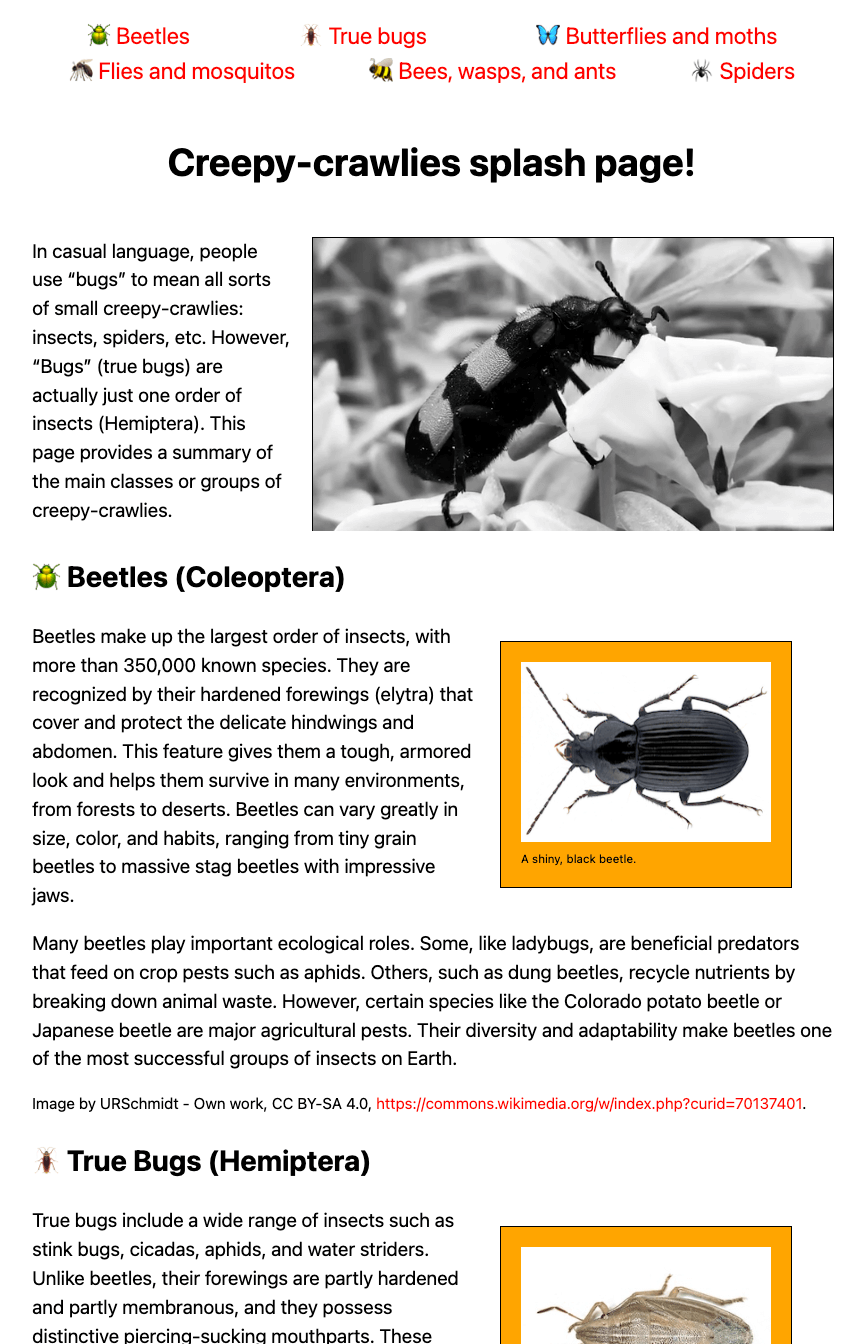
Ảnh chụp màn hình sau đây cho thấy trang splash sẽ trông như thế nào. Nếu bạn bị kẹt về cách đạt được một số điều này, hãy xem giải pháp bên dưới ví dụ trực tiếp.
Nhấp vào đây để hiển thị giải pháp
HTML hoàn chỉnh của bạn sẽ trông như thế này:
<!doctype html>
<html lang="vi">
  <head>
    <meta charset="utf-8" />
    <title>Creepy crawlies!</title>
    <link href="style.css" rel="stylesheet" />
  </head>
  <body>
    <header>
      <nav>
        <ul>
          <li><a href="#beetles">🪲 Beetles</a></li>
          <li><a href="#true_bugs">🪳 True bugs</a></li>
          <li><a href="#butterflies_moths">🦋 Butterflies and moths</a></li>
          <li><a href="#flies_mosquitos">🦟 Flies and mosquitos</a></li>
          <li><a href="#bees_wasps_ants">🐝 Bees, wasps, and ants</a></li>
          <li><a href="#spiders">🕷️ Spiders</a></li>
        </ul>
      </nav>
      <section>
        <h1>Creepy-crawlies splash page!</h1>

        <video
          src="https://mdn.github.io/shared-assets/videos/learn/bug_video_640.mp4"
          autoplay
          loop
          muted
          preload="auto"></video>

        <p>
          In casual language, people use "bugs" to mean all sorts of small
          creepy-crawlies: insects, spiders, etc. However, "Bugs" (true bugs)
          are actually just one order of insects (Hemiptera). This page provides
          a summary of the main classes or groups of creepy-crawlies.
        </p>
      </section>
    </header>
    <main>
      <section id="beetles">
        <h2>🪲 Beetles (Coleoptera)</h2>

        <figure>
          <img
            src="https://mdn.github.io/shared-assets/images/examples/learn/crawlies/beetle.png"
            alt="A black six-legged beetle with a shield-shaped body and long antennae"
            width="250"
            height="180" />
          <figcaption>A shiny, black beetle.</figcaption>
        </figure>

        <p>
          Beetles make up the largest order of insects, with more than 350,000
          known species. They are recognized by their hardened forewings
          (elytra) that cover and protect the delicate hindwings and abdomen.
          This feature gives them a tough, armored look and helps them survive
          in many environments, from forests to deserts. Beetles can vary
          greatly in size, color, and habits, ranging from tiny grain beetles to
          massive stag beetles with impressive jaws.
        </p>
        <p>
          Many beetles play important ecological roles. Some, like ladybugs, are
          beneficial predators that feed on crop pests such as aphids. Others,
          such as dung beetles, recycle nutrients by breaking down animal waste.
          However, certain species like the Colorado potato beetle or Japanese
          beetle are major agricultural pests. Their diversity and adaptability
          make beetles one of the most successful groups of insects on Earth.
        </p>

        <p class="copyright">
          Image by URSchmidt - Own work, CC BY-SA 4.0,
          <a href="https://commons.wikimedia.org/w/index.php?curid=70137401"
            >https://commons.wikimedia.org/w/index.php?curid=70137401</a
          >.
        </p>
      </section>
      <section id="true_bugs">
        <h2>🪳 True Bugs (Hemiptera)</h2>

        <figure>
          <img
            src="https://mdn.github.io/shared-assets/images/examples/learn/crawlies/true_bug.jpg"
            alt="A green, six-legged beetle with fairly long antennae and stripy markings"
            width="250"
            height="180" />
          <figcaption>A green stripey bug.</figcaption>
        </figure>

        <p>
          True bugs include a wide range of insects such as stink bugs, cicadas,
          aphids, and water striders. Unlike beetles, their forewings are partly
          hardened and partly membranous, and they possess distinctive
          piercing-sucking mouthparts. These mouthparts are adapted for feeding
          on plant sap, blood, or other insects. Many true bugs have scent
          glands that produce strong odors as a defense mechanism, which is why
          some are called "stink bugs."
        </p>

        <p>
          True bugs are found worldwide and occupy a variety of habitats,
          including plants, soil, and water. While some species are harmless or
          even beneficial predators, others are destructive agricultural pests
          that weaken plants by draining their sap. Certain bugs, like bed bugs
          and kissing bugs, can also affect humans directly by biting or
          transmitting diseases.
        </p>

        <p class="copyright">
          Image created by user B. Schoenmakers at Waarneming.nl, a source of
          nature observations in the Netherlands. - This image is uploaded as
          image number 29046158 at Waarneming.nl, a source of nature
          observations in the Netherlands.This tag does not indicate the
          copyright status of the attached work. A normal copyright tag is still
          required. See Commons:Licensing for more information. This site now
          requires authentication, however, the same image and copyright
          information is also available via
          <a href="https://world.observation.org/foto/view/29046158"
            >https://world.observation.org/foto/view/29046158</a
          >
          since it uses the same data, CC BY 3.0,
          <a href="https://commons.wikimedia.org/w/index.php?curid=92410673"
            >https://commons.wikimedia.org/w/index.php?curid=92410673</a
          >.
        </p>
      </section>
      <section id="butterflies_moths">
        <h2>🦋 Butterflies & Moths (Lepidoptera)</h2>

        <figure>
          <img
            src="https://mdn.github.io/shared-assets/images/examples/learn/crawlies/butterfly.jpg"
            alt="A butterfly with large black and orange wings"
            width="250"
            height="180" />
          <figcaption>A typical butterfly.</figcaption>
        </figure>

        <p>
          Butterflies and moths are some of the most recognizable insects thanks
          to their large, often colorful wings covered in tiny scales. These
          scales give their wings shimmering, patterned appearances and are one
          of the defining traits of this group. Butterflies are usually active
          by day, while moths are mostly nocturnal, though there are exceptions.
          Both undergo complete metamorphosis, with a dramatic transformation
          from caterpillar to winged adult.
        </p>

        <p>
          As caterpillars, they primarily feed on leaves, sometimes causing
          damage to crops and plants. As adults, butterflies and many moths are
          important pollinators, transferring pollen as they sip nectar from
          flowers. They are also ecologically vital as food sources for birds,
          bats, and other animals. Their beauty and ecological importance make
          them a favorite group for nature enthusiasts and scientists alike.
        </p>

        <p class="copyright">
          Image by Didier Descouens - Own work, CC BY-SA 4.0,
          <a href="https://commons.wikimedia.org/w/index.php?curid=19303857"
            >https://commons.wikimedia.org/w/index.php?curid=19303857</a
          >.
        </p>
      </section>
      <section id="flies_mosquitos">
        <h2>🦟 Flies & Mosquitoes (Diptera)</h2>

        <figure>
          <img
            src="https://mdn.github.io/shared-assets/images/examples/learn/crawlies/mosquito.jpg"
            alt="A hairy flying insect with long legs"
            width="250"
            height="180" />
          <figcaption>A mosquito.</figcaption>
        </figure>

        <p>
          Flies and mosquitoes belong to the order Diptera, meaning "two wings."
          Unlike most other insects, they have only one functional pair of
          wings; the hind pair has evolved into tiny balancing organs called
          halteres. This adaptation gives them incredible agility in flight.
          Their mouthparts vary widely: some species have sponging mouthparts
          (like houseflies), while others have piercing-sucking ones (like
          mosquitoes).
        </p>

        <p>
          These insects are among the most ecologically and medically
          significant. Many flies are decomposers, helping break down waste and
          recycle nutrients. Mosquitoes, however, are infamous as disease
          vectors, spreading malaria, dengue, and other illnesses. Despite their
          negative reputation, flies and mosquitoes are essential in ecosystems,
          serving as pollinators and as a major food source for many animals.
        </p>

        <p class="copyright">
          Image created by user Dick Belgers at Waarneming.nl, a source of
          nature observations in the Netherlands. This image is uploaded as
          image number 5105758 at Waarneming.nl, a source of nature observations
          in the Netherlands. This tag does not indicate the copyright status of
          the attached work. A normal copyright tag is still required. See
          Commons:Licensing for more information. CC BY 3.0,
          <a href="https://commons.wikimedia.org/w/index.php?curid=27659589"
            >https://commons.wikimedia.org/w/index.php?curid=27659589</a
          >.
        </p>
      </section>
      <section id="bees_wasps_ants">
        <h2>🐝 Bees, Wasps, Ants (Hymenoptera)</h2>

        <figure>
          <img
            src="https://mdn.github.io/shared-assets/images/examples/learn/crawlies/bee.jpg"
            alt="A furry black and yellow striped flying insect with six legs"
            width="250"
            height="180" />
          <figcaption>A bumblebee.</figcaption>
        </figure>

        <p>
          Bees, wasps, and ants are a diverse group known for their complex
          behaviors and social structures. Many species live in colonies with
          distinct roles for workers, queens, and males. Bees are especially
          famous for pollination, producing honey, and communicating with each
          other through dances. Wasps are often predators or parasitoids, while
          ants are skilled builders and cooperative foragers.
        </p>

        <p>
          This group has a huge ecological impact. Bees and wasps contribute to
          pollination, supporting food crops and wild plants. Some wasps help
          control pest populations by preying on or parasitizing other insects.
          Ants are critical soil engineers, aerating the ground and recycling
          nutrients. While stings and aggressive behaviors make some species
          feared, they are vital players in natural and agricultural systems.
        </p>

        <p class="copyright">
          Image by Trounce - Own work, CC BY-SA 2.5,
          <a href="https://commons.wikimedia.org/w/index.php?curid=1997709"
            >https://commons.wikimedia.org/w/index.php?curid=1997709</a
          >.
        </p>
      </section>
      <section id="spiders">
        <h2>🕷️ Spiders (Araneae)</h2>

        <figure>
          <img
            src="https://mdn.github.io/shared-assets/images/examples/learn/crawlies/spider.jpg"
            alt="A black bodied spider with eight legs, feelers, and jaws"
            width="250"
            height="180" />
          <figcaption>A spider.</figcaption>
        </figure>

        <p>
          Spiders are arachnids, not insects, and are easily distinguished by
          their eight legs and lack of antennae. Almost all spiders are
          predators, using venom and silk to capture prey. Many build intricate
          webs to trap insects, while others are active hunters that chase or
          ambush their food. Their silk is an incredibly strong and versatile
          material, used for webs, egg sacs, or safety lines.
        </p>

        <p>
          Spiders are found in nearly every habitat on Earth, from deserts to
          caves to homes. While some people fear them, very few species pose a
          danger to humans. In fact, spiders are highly beneficial because they
          help control insect populations, including pests. They play a crucial
          role in balancing ecosystems, making them one of the most important
          non-insect "bugs" people commonly encounter.
        </p>

        <p class="copyright">
          Image by AJC ajcann.wordpress.com from UK, CC BY-SA 2.0
          <a href="https://creativecommons.org/licenses/by-sa/2.0"
            >https://creativecommons.org/licenses/by-sa/2.0</a
          >, via Wikimedia Commons.
        </p>
      </section>
    </main>
  </body>
</html>